Moissanite vs. Diamond: What's the Real Difference?
In This Article:
- The Sparkle: Brilliance vs. Fire
- Durability: Built for Daily Wear
- 2026 Price Comparison
- Frequently Asked Questions
- See the Difference in Person
If you are beginning your engagement ring journey in 2026, you have likely noticed that "the diamond" is no longer the only star in the sky. Moissanite has exploded in popularity, offering a look that rivals diamonds at a fraction of the cost.
At Jewelry Authority, our GIA-trained gemologists are often asked: "Is it a fake diamond?" The answer is no. Moissanite is a unique, naturally occurring mineral (silicon carbide) that is now created in labs for jewelry. While it looks remarkably like a diamond, it has its own distinct personality. Here is how they stack up side-by-side. If you're weighing lab-grown diamonds too, see our lab-grown vs. natural diamonds guide.
1. The Sparkle: Brilliance vs. Fire
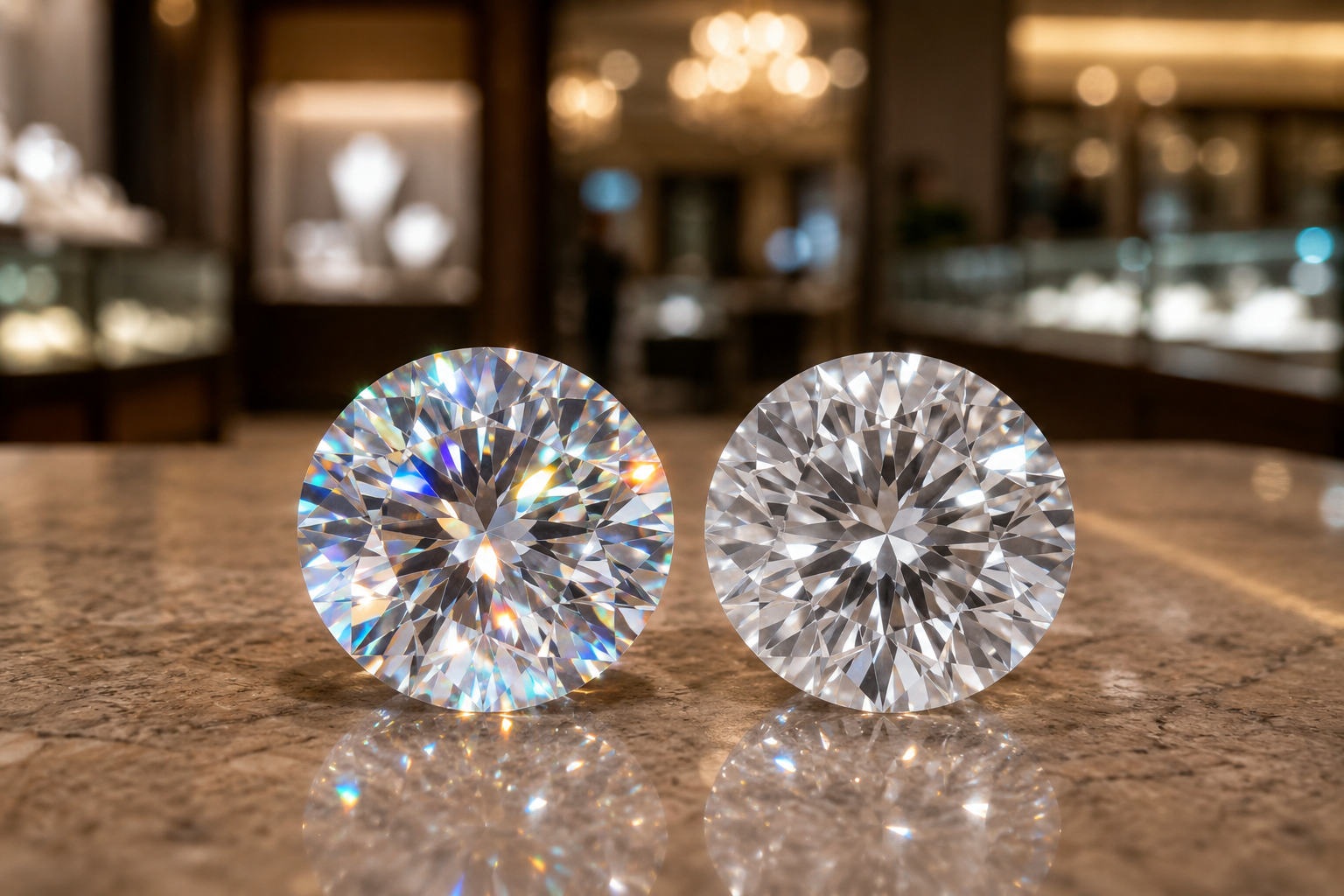
To the naked eye, both stones are breathtaking, but they reflect light differently.
- Diamond: Known for its "Brilliance"—the white light reflected from the stone. It offers a classic, sophisticated sparkle.
- Moissanite: Known for its "Fire" or "Dispersion." Moissanite has a higher refractive index than a diamond, meaning it produces more "rainbow flashes." In bright sunlight, a moissanite can look like a disco ball of color compared to the more subtle diamond.
2. Durability: Built for Daily Wear
An engagement ring needs to withstand a lifetime of use.
- Diamond: The hardest known material, ranking a 10 on the Mohs Scale. It is virtually scratch-proof.
- Moissanite: Ranks a 9.25 on the Mohs Scale. While slightly "softer" than a diamond, it is harder than sapphires or rubies. It is exceptionally durable and suitable for everyday wear. Crucially, moissanite will not get cloudy over time. Any dullness is usually just surface residue (lotions/soaps) that a professional cleaning at our Greensboro showroom will instantly fix.
2026 Price Comparison: 2.0-Carat Round Brilliant
The most significant difference is the impact on your budget.
| Feature | Moissanite | Lab-Grown Diamond | Natural Diamond |
|---|---|---|---|
| 2026 Est. Price | ~$1,300 | ~$3,000 - $8,000 | ~$15,000+ |
| Hardness | 9.25 | 10 | 10 |
| Sparkle Style | Rainbow "Fire" | Classic White "Brilliance" | Classic White "Brilliance" |
| Rarity | Lab-Created | Lab-Created | Mined / Finite |
Frequently Asked Questions
Does moissanite pass a diamond tester?
Sometimes. Traditional diamond testers work by measuring thermal conductivity (heat). Because moissanite conducts heat similarly to diamonds, it can "trick" basic testers. However, at Jewelry Authority, we use advanced multi-testers that measure electrical conductivity, which can instantly and accurately tell the difference.
Can you tell the difference with the naked eye?
For stones under 1 carat, it is very difficult for the average person to tell the difference. As the stone gets larger (2+ carats), the "double refraction" of moissanite becomes more apparent to an expert eye, as it creates a more intense rainbow effect than a diamond.
Is moissanite a good choice for an engagement ring?
In 2026, many couples are choosing moissanite because it allows them to maximize their stone size while remaining debt-free. It is a sustainable and high-performance choice. Browse our engagement collection to see settings in person.
Is it "less meaningful" than a diamond?
The meaning of a ring comes from the commitment it represents, not the chemical composition of the stone. Whether you choose a billion-year-old natural diamond or a high-tech moissanite, the sentiment remains the same.
See the Difference in Person
Choosing between moissanite and diamond is a visual decision. We invite you to visit one of our Greensboro showrooms, where we can place both stones side-by-side under the microscope for you. Prefer a fully bespoke piece? Learn how custom engagement rings are made.
Ready to compare? No appointment is necessary. Come talk to our GIA gemologists and find the stone that fits your style and your budget perfectly.